

B.C.’s median income rose in 2020 as national poverty rates declined

A report from Statistics Canada shows that the median income in British Columbia was $67,500 in 2020.
The figures from the 2020 Canadian Income Survey (CIS) marked a 7.1 per cent, or $4,500 increase from the previous year.
The report also noted that the national median income was up 7.1 per cent, or $4,400, to $66,800 in 2020.
B.C. recorded the fourth highest median income that year after Alberta ($77,700), Ontario ($70,100), and Saskatchewan ($67,700).
Nova Scotia recorded the largest increase as the median income rose 7.8 per cent from $53,300 in 2019 to $57,700 in 2020.
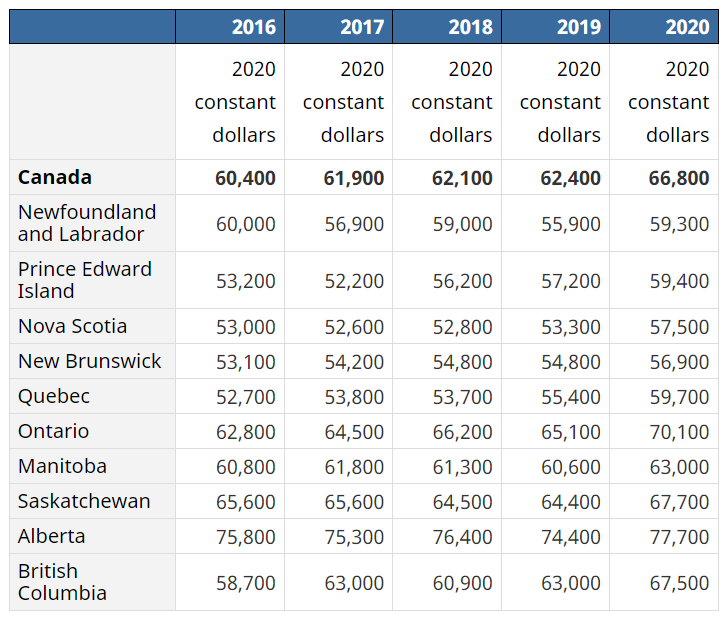 Median incomes on a year-over-year basis (graphic courtesy of Statistics Canada)
The number of Canadians living below the poverty line fell to 2,357,000, or 6.4 per cent of the population. That reflects a decrease of 1,436,000 people, or 3.9 per cent of the population, from the number of people living below the poverty line in 2019.
StatsCan data showed that while the rates were down across the board on a year-over-year basis, the highest rates of people living below the poverty line were people age 18 to 64 not in an economic family (27.1 per cent) and people under the age of 18 in female lone-parent homes (16.9 per cent).
An economic family refers to two or more people living in the same household related by blood, marriage, common-law union, adoption or foster relationships.
People age 18 to 64 living in economic families had the lowest rate of living below the poverty line at 1.3 per cent.
It was also noted that, by demographic group, people under the age of 18 in female lone-parent families had the highest rate of people living under the poverty line, followed by First Nations people age 16 years and over living off-reserve at 15.2 per cent.
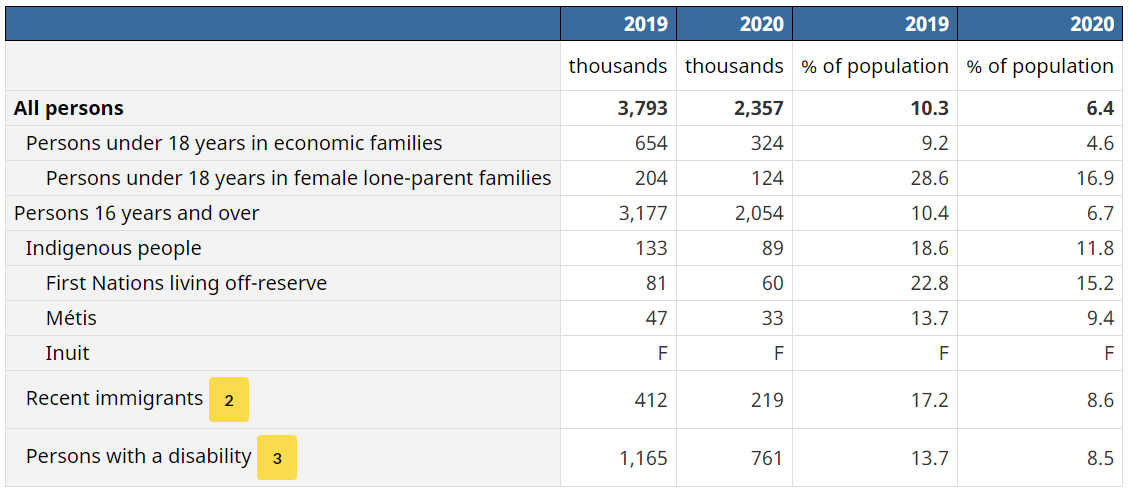 Canadians living below the poverty line by selected demographic group (graphic courtesy of Statistics Canada)
The data also showed that Canada’s poverty rate for children dropped to 4.7 per cent, reducing the number of children in poverty by 50 per cent.
Statistics Canada noted that the study was held in 2020 during the COVID-19 pandemic, when the government was ordering temporary closures of non-essential businesses, travel restrictions, and public health measures, which resulted in a dramatic slowdown in economic activity.
Though there were challenges, StatsCan said not all of the impacts were felt equally, noting that the average market income for families and unattached individuals fell about 20 per cent in the bottom 20 per cent and 10 per cent in the second-lowest quintile, the upper 20 per cent did not see any changes to their income.
In response to the losses in employment and earnings, people turned to Canada’s income support measures, the Canada Emergency Response Benefit, the Canada Recovery Benefit and the Canada Emergency Student Benefit. The CIS report shows that these programs provided approximately $82 billion in income support to 8.1 million Canadian families and unattached individuals, with the median amount in support being $8,000.
These measures, along with other government programs like the Canada Child Benefit, Employment Insurance, Old Age Security and the Canada Pension Plan, allowed Canadian families and individuals to collect over $16,000 in 2020.
It’s stated that these benefits helped offset declines in the market income, resulting in an increase in after-tax income, which was proportionately larger for lower-income families and individuals. In 2020, the bottom 20 per cent reported an after-tax increase of 16.2 per cent, while the second-lowest quintile saw an increase of 8.5 per cent. The top 20 per cent of earners in Canada saw their after-tax income grow by 2.4 per cent in the same year.
StatsCan said though the labour market continued to be impacted by COVID-19 and health measures in 2021, there were improvements in economic activity and employment.
Economy-wide estimates show that the decrease in income inequality is expected to continue as disposable income for households in the bottom 20 per cent or earners in Canada is increasing.
It’s also noted that the trends in inflation could have an impact on real income levels and income poverty rates in 2021.
The 2021 CIS is expected to be released in early 2023.